As someone who has spent years working with global brands, I’ve developed what I jokingly call a professional reflex. Whenever I see a product or service – be it a marketing campaign, a brand name, a piece of UX – I instinctively ask: How would this land in France? Or in Brazil? Or Japan?

It’s a habit I’ve picked up over time, and by now it feels more like instinct than conscious analysis. Call it an obsession, or maybe a kind of trained empathy. Whatever it is, it’s always running in the background.

So when generative AI tools exploded into the mainstream, it was only natural that I began wondering how they might land differently around the world. Not just in terms of the languages they support or the accents they mimic, but the deeper assumptions behind how they speak, suggest, decide, and behave.

Would people in different countries feel comfortable with the way AI chats with them? Would it come across as friendly or intrusive? Empowering or alienating? Would it understand local humour? Would it know what not to say?

More importantly…would people trust it?

I find myself asking a different kind of question these days, knowing full well the answers are complex. Because this time, we’re not just localising products or messaging. We’re localising intelligence.

The AI Index Report Confirmed What I Suspected

I recently came across the 2025 AI Index Report, which offers a compelling snapshot of global public opinion on AI – and reveals deep regional divides in how its benefits are perceived.
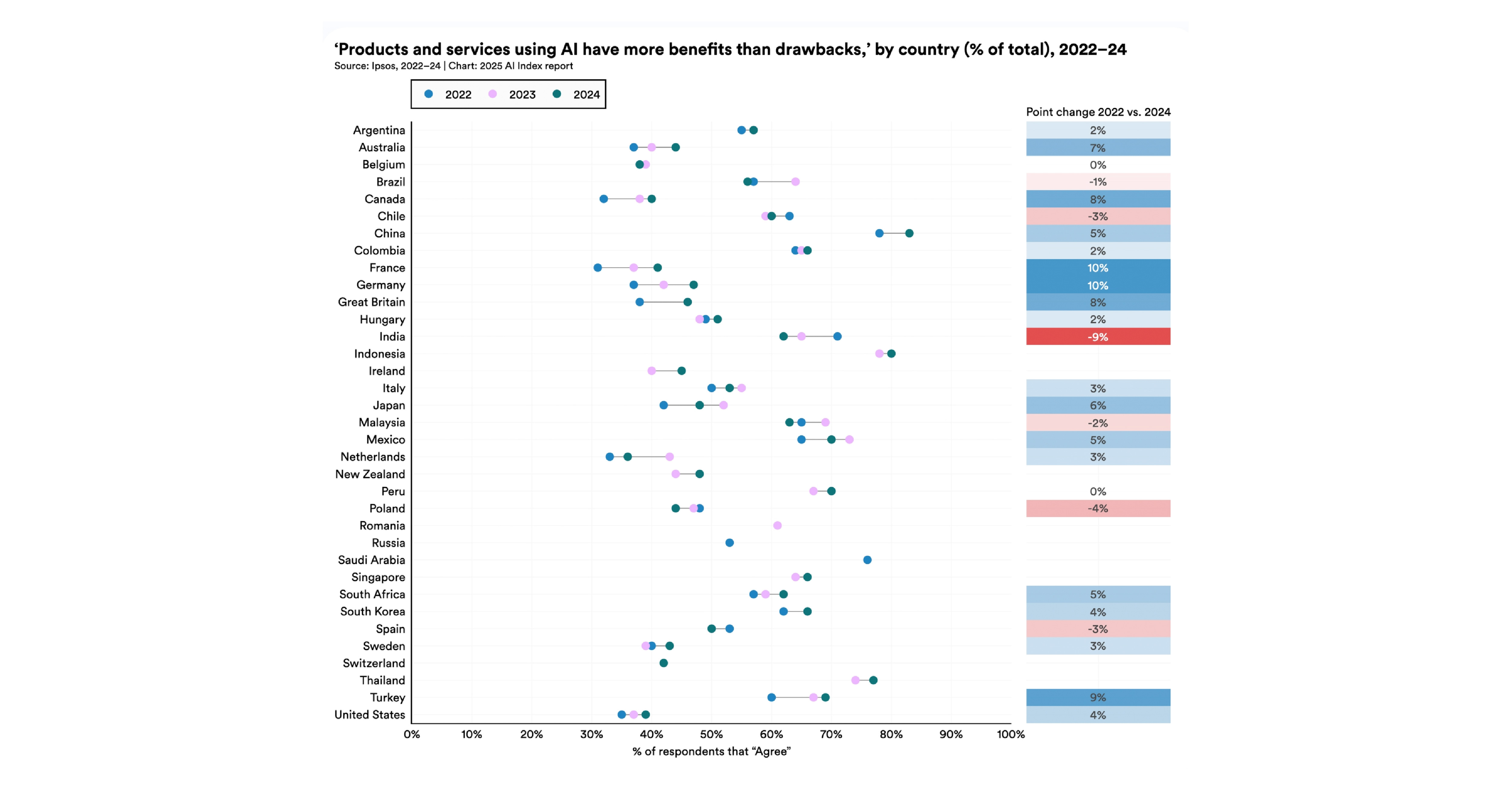
In countries like China (83%), Indonesia (80%), and Thailand (77%), strong majorities see AI as offering more benefits than drawbacks. Contrast that with Canada (40%), the U.S. (39%), and the Netherlands (36%), where public sentiment remains far more sceptical. And even in places where optimism is growing, concerns around fairness, bias, and trust remain stubbornly persistent.

This disparity is telling. It suggests that people are not responding to AI in the same way everywhere – and that those responses are shaped not just by access or infrastructure, but by something more layered: cultural context, historical memory, societal norms, and collective trust.

AI, in other words, isn’t a neutral technology moving through the world. It’s a phenomenon being interpreted through different lenses – and carrying different meanings as it does so.

AI Doesn’t Have a Global Image. It Has Many.

What struck me most from the report was this: AI, when productised, doesn’t behave like a single brand with a uniform reputation. It’s not Coca-Cola. It’s not the iPhone.

Instead, it’s a fragmented phenomenon – perceived as liberating in one country, suspicious in another, potentially job-threatening here, and educational there.

This fragmented global reception has profound implications for how AI products are built, marketed, adopted, and governed.

Let me illustrate a few thoughts on how this plays out across different domains:

For AI startups, the typical focus is on functionality and scale. But if AI’s meaning shifts from culture to culture, product-market fit must also include a “cultural trust fit.” Messaging around innovation, productivity, or augmentation needs to be contextualised: is AI seen as empowering? Intrusive? Inevitable? Alienating? Startups entering new markets must do more than translate interfaces – they must translate intent. For example, a generative AI writing tool marketed in the U.S. might lead with productivity and creativity; in France, it may need to speak more to artistic integrity and cultural authenticity.

For consumer brands touting their “AI-first” transformation, there’s a risk in assuming AI always signals progress. Recent backlash faced by Duolingo and Klarna shows what happens when users perceive AI as replacing, rather than enhancing, the human touch. In low-optimism markets like Canada, the U.S., and the Netherlands, AI branding can trigger anxiety rather than excitement. Brands must learn to balance global AI positioning with local storytelling. In some markets, “AI-enhanced” may resonate more than “AI-first.” Bringing in local influencers, educators, or creators can serve as cultural bridges that build trust.

Let’s Talk About Model Behaviour

If the perception of AI varies across cultures, then surely the behaviour of AI models should reflect that too. And yet many of today’s most powerful systems – ChatGPT, Claude, Gemini – are trained largely on English-language, Western-centric data. They perform impressively across languages, but that doesn’t mean they grasp cultural nuance or behavioural expectations.

Translation isn’t localisation. Speaking a language correctly isn’t the same as knowing when to be formal, when to show deference, or when to exercise restraint. Tone, timing, and formality are culturally constructed.

An AI assistant that’s optimised for American norms might interrupt too quickly in Japan—or sidestep topics that, in another context, are essential to address. What’s seen as helpful in one country might be interpreted as evasive or inappropriate in another.

We’ve long accepted that brands need regional voices. Why shouldn’t AI?

Model Builders Are Starting to Pay Attention

For a while, it seemed this challenge was being overlooked in the rush to scale. But lately, signs of change are emerging.

At VivaTech 2025, I listened to a keynote by Jensen Huang, CEO of NVIDIA. To my surprise – and relief – he raised many of the same questions that had been circling in my mind. His talk focused on digital sovereignty and global ecosystems, and he laid out a vision in which AI models aren’t one-size-fits-all, but rather regionally grounded, culturally intelligent, and ethically plural.

He introduced NeMoTron, NVIDIA’s initiative to support the development of open, adaptable, region-specific large language models. It marked a significant shift – not just technically, but ideologically.

Rather than striving for a universal model that behaves the same everywhere, NeMoTron is built to be adapted, linguistically, behaviourally, even ethically, to suit local needs. It can be fine-tuned on proprietary data, embedded with national regulatory frameworks, and enriched with historical knowledge often missing from Western-centric training sets.

When paired with Perplexity, a partner focused on grounding AI responses in local sources, linguistic norms, and real-time cultural cues, we start to see a future that’s not just intelligent, but pluralistic by design.

From Brand Strategy to Model Design: A Common Lesson

In many ways, this mirrors what global marketers have long understood. The most successful global brands don’t impose one voice across every market. They build a strong, consistent identity, but they allow that identity to flex and adapt.

The same principle should apply to AI.

The goal isn’t to splinter AI into dozens of incompatible systems. It’s to build modular, configurable, and culturally fluent AI experiences that reflect the richness of human difference.

That means:

Rethinking alignment – not as a universal doctrine, but as something to be co-created with local communities.

Designing model behaviour – not just training data – with cultural values in mind.

Embedding localisation not just in content, but in the AI’s tone, persona, and ethical framing.

Toward a Culturally Attuned Intelligence

AI is fast becoming a companion technology – a tool we speak to, and that speaks back. As it takes on this role, the question isn’t just whether it understands us, but how well it reflects who we are, where we are, and what matters to us.

Cultural nuance isn’t an afterthought. It’s the foundation of trust, usability, and relevance.

If AI is to earn its place as a meaningful presence in everyday life, it must learn to do what any respectful guest in a new place does: listen first, speak with care, and adapt to the room.

It’s not enough to build intelligent systems.

We need to build attuned ones.

I stumbled upon an image on facebook recently and it had stuck in my mind for a long time. It’s a facebook page of InterContinental Hotels where guests post snapshots of the hotel from all over the world. It’s a fantastic collection not because it is completely from the eyes of the consumers; it also illustrates one interesting thing – the hotel looks and feels so differently in each market.

This got me thinking…how does brand consistency apply in this context? Is consistency really relevant after all? Or perhaps we need to redefine the conventional definition of consistency?

What about global brand guidelines? We often hear branding specialists emphasize that in order to maintain global brand consistency, local markets need to be provided with over-arching guidelines about presentation, logo use, images and tone of brand messages, often in a manifesto or marketing book. However, many of these brand guidelines are over simplifications or generalizations that often have not allowed the breath of thinking.

I think consistency is an attitude. It’s more about the ‘how’ than ‘what’.

Intelligently local

As brands become more national, multinational or global, they realize that not all the consumers in each market have the same needs.  The need for global brands to be transformed and make sure they are locally relevant is increasingly important. In the travel industry, for example, hotel brands have been increasingly adapted to the local needs.

Accor has revamped its Grand Mercure brand in China, offering products and services tailored for local clientele, in a move aimed at taking advantage of the booming upscale domestic travel market.

Grégoire Champetier, chief marketing officer of Accor said “Our clients are now expecting brands capable of understanding the diversity and the complexity of their identity.”

The re-engineered branding for Grand Mercure, referred to in Mandarin as Mei Jue (美爵), was unveiled at the inauguration of Grand Mercure Shanghai Zhongya, the first hotel adapted to the new positioning. The group’s nine other similarly branded properties in China are due to adopt the new identity.

In Shanghai, employees will be conversant in the local Shanghainese language (a dialect that is class-defining in mainland China), and guests will be welcomed by staff wearing Qipao, a traditional evening dress (Think Maggi Cheung in the Mood for Love).

All local staff will be identified with name badges bearing firstly Chinese characters, followed by a pinyin equivalent enabling them to use their given names rather than adopting foreign equivalents.

Other signature services include daily Tai chi lessons, and complimentary head and shoulder massages (Chinese style presumably) for guests staying on premium floors.

The Grand Mercure brand provides Accor with a fresh platform for organic upscale expansion throughout the country. The opportunity for organic growth in the upscale hotel segment in China is one of the largest in the world. Accor’s tailor-made Grand Mercure product has already garnered great support from hotel owners. Accor currently operates 10 Grand Mercure hotels in the country. Accor has confirmed commitments for 10 additional hotels, and announced that it will expand its network to around 65 hotels in tier 1 to tier 3 cities throughout China by 2015.

Authentic global

The concept of globalization often carries a dose of negativity. By definition, globalization means the ‘process by which the peoples of the world are incorporated into a single world society’, which indicates the process of standardisation. However, in an increasingly interconnected global economy, many of us cherish our local roots. Some global brands understand that and promote ‘now localism’ in their brand strategy.

Hotel Indigo is what IHG considered to be their nearest to a non-hard brand.

As their CFO of EMEA and head of development for Europe for IHG, Paul Edgecliffe-Johnson, once said “A good brand is one that does a lot of research into what consumers want and designs something around that”. In fact they have put this in practice and bring in the feeling of the locale wherever they go. For example in Liverpool, the hotel focus on the music scene, in Shanghai it captures a strong Chinese-feeling.

Bart Carnahan, senior VP for acquisitions and development of Starwood Hotels & Resorts Worldwide once commented on the pros and cons of hard branding versus soft branding: “St. Regis for us is hard-branded—you know what you’re getting”. Luxury Collection is getting close to these white brands, it has some core consistencies throughout those brands, but it gives more breadth to owner developers, so it’s not so rigid. Carnahan said Starwood’s upscale brands have to have local designs to get that eclectic local feeling and the company wants some of the luxury brands to be.

Not just local, it’s your neighbourhood

Going one step further, the notion of ‘place’ is such a core of the proposition that certain brands has gone all out to adapt to local market needs. Statbucks is one such brand. In Seattle, 15th Avenue Coffee & Tea looks nothing like a Starbucks. But, this new café, named after the street where it is situated, is a Starbucks. Starbucks has decided to un-brand it’s newest location in Washington DC. By featuring local entertainment, sourcing from local bakeries and donating leftover food to the local parish, these new un-branded cafés aim to integrate themselves into the fabric of the neighbourhood.

Consumers are turning away from the allure of globalization and massive brands for the comfort of localization. In the US, we stand poised to see the resurgence of neighbourhood. How can your brand capture local character and appeal to consumers’ by providing them with a greater sense of identity and belonging?

Here, I am leaving with you some food for thoughts:

What consistency means in global brand management nowadays? Does it need to be redefined?

If brands need to be localized, what are the impact in the process of creating and implementation of global campaign?

If one-size-fits-all marketing tactic does not work for certain product categories, what are the implications of adapting global ideas for local markets?

What do you think?

Apart from a few obvious global giants, few brands establish dominant positions in multiple markets. Often this has become one of the main challenges for brands to create one single global creative platform.

There are a number of reasons behind it. Different perception and taste of the product is one, what I call the ‘marmite effect’. Or the product could simply be reaching a totally different product life cycle in each local market. Orangina is one such example.

When Miss O meets Tora-san

In France, the brand began its production in 1963 and has been so established that, arguably, it has become a lifestyle brand. In its popular advertising featuring the classic Orangina Rouge to the controversial ‘furry animals’ campaign back in 2008 through to the most recent ‘Miss O’ creative platform, it’s all about creating buzz and keeping the brand fresh and current in the mind of consumers. It’s what’s outside that counts!

In the new series of spots by Fred & Farid Paris directed by Joseph Kahn, the lady wolf is portrayed as a heartbreaker, in “Working late” she lies to her wimpy boyfriend and then in “Dump”, she breaks up with him in a very public way. The work, centred around the wolf, who is Miss O, asks you who really is the boss when it comes to relationships.

The local culture also provides a perfect playground for such creative platform to flourish, share and engage. The tagline “C’est qui le sexe fort?” (creatively adapted as “Who is the boss” or literally means “Which is the strong sex?”). Interestingly, the French consumers with GSOH are not steered to take the message literally, and the creative idea was instantly recognised, accepted and embraced.

On the other side of the globe in Japan, Suntory acquired the Orangina brand in 2009 and the new-look Orangina replacing the classic pear-shaped bottle was just launched in March. As a relatively new brand in the market, being French has its advantage. The recent ‘Toro-san’ campaign featuring Richard Gere rides on that ‘foreignness’ and was distinctively designed for that market.

In the launch commercial, Richard Gere appears as Tora-san, the lovable ‘loser’ in Shochiku’s very popular 48-film series of Japanese comedy movies entitled 『男はつらいよ』(It’s Tough Being a Man). Not only is he a contemporary adaptation of the original character played by Kiyoshi Atsumi, the commercials also use the same iconic music “Otoko wa Tsuraiyo” from the series.

The original Tora-san in 『男はつらいよ』:

The underlying message is that the brand is a western idea adapting within the framework of the Japanese culture. By riding on the character of Tora-san who is famous for being a bumbling Mr. Everyman, gives the brand personality a distinctive western dimension.

George Field wrote in his book “From Bonsai to Levis” (1983), and commented that in Japan culture, contrary to the stereotype, the woman is the boss (in the context that Japanese women control the purse strings in the family and are well positioned to occupy the seat of power).

There is an intriguing irony between the dominating ‘Miss O’ and humble ‘Tora-san’ here. Though I have a feeling that it is just a happy co-incidence, I cannot help but imagine what if ‘Tora-san’ meets ‘Miss O’, could that be a marriage made in heaven?

Could that be a cross-border joint production and creative adaptation?

One might argue that going for a completely localised approach, it means that it will be a long way when Orangina can create a truly global brand that captures a common language as in the case of some other globally aligned beverage brands.

For the time being, the brand may not be able to take advantage of the costs efficiency enjoyed by creating a centralized global idea that many marketers aim for, but they certainly give the brand an opportunity to grow with the local market at the right time, in the right place. This also reinforces the belief that there is no single, optimal answer to the question of how to manage a global brand.