It’s Chinese New Year on February 19. The Spring Festival is regarded as the most vibrant gift giving and shopping season in China, and therefore one of the major push for many leading brands. Many global advertisers follow the same old formula year after year, while others try to break away from the norm and do something different.

Pepsi curated a “crowd-sourced video” inviting consumers to submit 15-second videos via Mei Pai 美拍, a local mobile video app, to form a tribute to family reunions. The crowd-sourced final cut video will be eventually simulcast on the big screen in New York’s Times Square, symbolically bringing something local to a global stage. At the same time, the “Bring Happiness Home” themed promotion will deliver over 2000 postal parcels to help the mothers in the remote mountainous regions get through the cold winter days.

Apple, on the other hand, had taken this opportunity to unveil their first TV commercial produced specifically for the China market.

It has been an epic few months of localization activities for Apple. Recently they have opened five new stores timed right before the Chinese New Year. Four of the stores are in brand new cities for the brand including Zhengzhou, capital of central China’s Henan Province, West Lake in Hangzhou, Zhejiang Province. In each location, they have strategically partnered up with local artists such as Wang Dongling and painter Yangyang Pan to co-create signature murals inspired by each city for the local store.
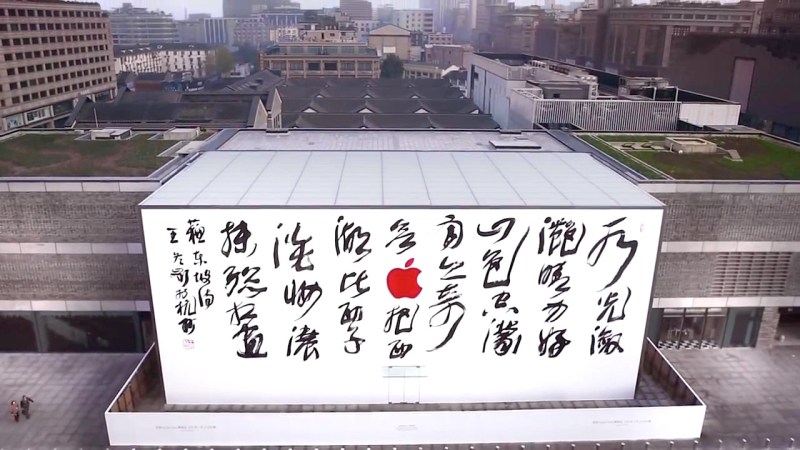
Apple Store, West Lake - About the Artist_00000

The TV commercial for Chinese New Year has been met with mixed criticisms. Directed by Ann Hui, best known for her films surrounding the topics of social issues, and cinematography by Christopher Doyle, a key collaborator in many films by Wong Kar Wei. However, you can hardly trace their signature style in the production. One of the main reasons, perhaps, is because they had to follow the tight guidelines imposed on the production – it has to be “consistent” with the global version. The story bears an almost identical storyline to a commercial entitled “The Song” released in the United States over the Christmas season in December 2014.

US “The Song”

http://youtu.be/WRsPnzcZ1VY

China “Old Song”

Even though it is by large a just a localized version, but at the very least, there is a strong and relevant proposition. The storyline cleverly positions the brand being the bridge between the younger generation and the old, and technology plays a role in connecting the emotions across generations.

Different brands tend to adopt a different approach to localize brand messages for local market. In the old model, creating the localized version often involves so many levels at the client side. Depending on the category of the product, it could involve anyone from the local marketing team, the regional marketing team and of course ultimately the global brand team. During the process, any form of innovative thinking will be filtered, reduced, modified, tweaked, abandoned, shot down, reinterpreted or misinterpreted.

Any creatives who had worked within international network agencies on global brands will know the challenges. Fortunately, some global brands are now doing it differently.

Apple now adopts a centralized approach – global ideas being conceived centrally, while implementation and production being done locally. Local content are developed following the global guidelines. Pepsi has adopted a more locally driven approach, leveraging current consumer trends that resonate well in the local market. While brands like Microsoft, they have established processes such as “global-readiness audit” to make sure the ideas and executions can travel well.

No matter which strategy you decide to adopt, one thing is for certain – if you want a cohesive global brand at all, you do need to think global at the time when the idea was conceived. The key to success is to create a truly global platform, which could be so fluid that it allows local interpretations without losing its integrity.

Most global brands prefer the 80-20 ratio of global-local content – to adopt 80% of the content centrally and globally, and allow local market to reiterate and adapt 20% of the content to enhance local relevancy. I personally advocate the 70-20-10 model in which 70% of efforts focus on delivering quality global communications riding on universal truth, 20% on pushing the boundaries to contextualize it with local nuances, and 10% on ideas and approaches which are unproven but could transform the marketplace in each local market.

Which model works best for you highly depends on how you structure the global-local team, and where you put the right kind of resources.

It’s also not easy to motivate creatives to get all excited to work on adapting global ideas, but you can create the space and environment to allow creativity to grow. Here are a few tips:

  • Human insights trump cultural ones. Avoid merely dressing up the global ideas but rather go deep into the reasons why, because that’s what true consistency is all about.
  • Nothing should stop you from creating something that is uniquely local; using very native expressions as long as underlying it there is a meaningful concept that everyone understands.
  • Construct a platform that local teams can “build on it” fluidly and not wasting their time to think of how to make it work.
  • Give anyone on the ground the tools and resources to thrive in scale. Be brutal in keeping the platform intact and trust your own instinct.
  • Consensus is not about everyone agreeing, it’s about everyone being heard and the rallying around the best answer. Never go for the lowest common denominator.
  • You can’t tell creative people to be creative, but you can let them.

I wish everyone a prosperous year of creativity.

I stumbled upon an image on facebook recently and it had stuck in my mind for a long time. It’s a facebook page of InterContinental Hotels where guests post snapshots of the hotel from all over the world. It’s a fantastic collection not because it is completely from the eyes of the consumers; it also illustrates one interesting thing – the hotel looks and feels so differently in each market.

This got me thinking…how does brand consistency apply in this context? Is consistency really relevant after all? Or perhaps we need to redefine the conventional definition of consistency?

What about global brand guidelines? We often hear branding specialists emphasize that in order to maintain global brand consistency, local markets need to be provided with over-arching guidelines about presentation, logo use, images and tone of brand messages, often in a manifesto or marketing book. However, many of these brand guidelines are over simplifications or generalizations that often have not allowed the breath of thinking.

I think consistency is an attitude. It’s more about the ‘how’ than ‘what’.

Intelligently local

As brands become more national, multinational or global, they realize that not all the consumers in each market have the same needs.  The need for global brands to be transformed and make sure they are locally relevant is increasingly important. In the travel industry, for example, hotel brands have been increasingly adapted to the local needs.

Accor has revamped its Grand Mercure brand in China, offering products and services tailored for local clientele, in a move aimed at taking advantage of the booming upscale domestic travel market.

Grégoire Champetier, chief marketing officer of Accor said “Our clients are now expecting brands capable of understanding the diversity and the complexity of their identity.”

The re-engineered branding for Grand Mercure, referred to in Mandarin as Mei Jue (美爵), was unveiled at the inauguration of Grand Mercure Shanghai Zhongya, the first hotel adapted to the new positioning. The group’s nine other similarly branded properties in China are due to adopt the new identity.

In Shanghai, employees will be conversant in the local Shanghainese language (a dialect that is class-defining in mainland China), and guests will be welcomed by staff wearing Qipao, a traditional evening dress (Think Maggi Cheung in the Mood for Love).

All local staff will be identified with name badges bearing firstly Chinese characters, followed by a pinyin equivalent enabling them to use their given names rather than adopting foreign equivalents.

Other signature services include daily Tai chi lessons, and complimentary head and shoulder massages (Chinese style presumably) for guests staying on premium floors.

The Grand Mercure brand provides Accor with a fresh platform for organic upscale expansion throughout the country. The opportunity for organic growth in the upscale hotel segment in China is one of the largest in the world. Accor’s tailor-made Grand Mercure product has already garnered great support from hotel owners. Accor currently operates 10 Grand Mercure hotels in the country. Accor has confirmed commitments for 10 additional hotels, and announced that it will expand its network to around 65 hotels in tier 1 to tier 3 cities throughout China by 2015.

Authentic global

The concept of globalization often carries a dose of negativity. By definition, globalization means the ‘process by which the peoples of the world are incorporated into a single world society’, which indicates the process of standardisation. However, in an increasingly interconnected global economy, many of us cherish our local roots. Some global brands understand that and promote ‘now localism’ in their brand strategy.

Hotel Indigo is what IHG considered to be their nearest to a non-hard brand.

As their CFO of EMEA and head of development for Europe for IHG, Paul Edgecliffe-Johnson, once said “A good brand is one that does a lot of research into what consumers want and designs something around that”. In fact they have put this in practice and bring in the feeling of the locale wherever they go. For example in Liverpool, the hotel focus on the music scene, in Shanghai it captures a strong Chinese-feeling.

Bart Carnahan, senior VP for acquisitions and development of Starwood Hotels & Resorts Worldwide once commented on the pros and cons of hard branding versus soft branding: “St. Regis for us is hard-branded—you know what you’re getting”. Luxury Collection is getting close to these white brands, it has some core consistencies throughout those brands, but it gives more breadth to owner developers, so it’s not so rigid. Carnahan said Starwood’s upscale brands have to have local designs to get that eclectic local feeling and the company wants some of the luxury brands to be.

Not just local, it’s your neighbourhood

Going one step further, the notion of ‘place’ is such a core of the proposition that certain brands has gone all out to adapt to local market needs. Statbucks is one such brand. In Seattle, 15th Avenue Coffee & Tea looks nothing like a Starbucks. But, this new café, named after the street where it is situated, is a Starbucks. Starbucks has decided to un-brand it’s newest location in Washington DC. By featuring local entertainment, sourcing from local bakeries and donating leftover food to the local parish, these new un-branded cafés aim to integrate themselves into the fabric of the neighbourhood.

Consumers are turning away from the allure of globalization and massive brands for the comfort of localization. In the US, we stand poised to see the resurgence of neighbourhood. How can your brand capture local character and appeal to consumers’ by providing them with a greater sense of identity and belonging?

Here, I am leaving with you some food for thoughts:

What consistency means in global brand management nowadays? Does it need to be redefined?

If brands need to be localized, what are the impact in the process of creating and implementation of global campaign?

If one-size-fits-all marketing tactic does not work for certain product categories, what are the implications of adapting global ideas for local markets?

What do you think?