Advertising is a reflection of our times. It always has been.
Advertising of brands, like music and movies, can be a social message in itself. It influences how we look, what we eat and sometimes how we see ourselves.
So when brands join force with another global and cultural phenomenon, such as sports, it can be even more powerful.
Brands want to be more “human”, and are a lot more open-minded to have a point of view. They understand in order to do this genuinely they need to allow people to have a voice.
Athletes understand their roles in the society and are more authoritative than ever to choose what brand they like to use as a platform to allow them to have a voice, and represent their values.
But in a commercial world, brands have a lot to be accounted for.
Brands have every pressure from the shareholders to invest only in messages that guaranteed sales growth.
Brands have every right to avoid associating with sensitive political issues.
Brands have all the reasons to communicate a message that appeals to “everyone”.
Thank goodness Nike is not such a brand.
The recent Nike campaignmakes no direct reference to any political viewpoints, but by featuring Colin Kaepernick (among Lebron James, Serena Williams and a slew of other athletes), the association to his protest against racial injustice, and decided to kneel rather than stand for the national anthem before a 2016 National Football League preseason game is clear.
What’s so compelling about the Nike message is not because it’s charged with one of the most sensitive political messages at the moment, and confronting face to face with one of the most controversial leaders in American history, it’s the pure fact that this is so true to what we know about the brand – someone who has the courage to speak his/her mind, and giving people of any background the space to expression theirs.
Not every brand can do this though. Any brand who hasn’t got that long established history of credential and integrity, will come out feeling sheer opportunistic.
The clever approach of Nike is that it does not have to express a single point of view but just create a stage for the broad range of people to express the breadth of their standpoints. In the process, bring people of many different backgrounds together.
It makes the brand feels more human, an advocate of freedom of speech rather than siding with one point of view.
True, after the news went viral, it pulled waves of both support and backlash, even boycott. The brand’s shares dipped in reaction to the news. But on the other hand, the campaign also received millions of dollars of media exposure. Perhaps all these have fulfilled the brand’s calculated cost benefit analysis, in communicating the message of an inclusive world for all.
Even if some people don’t agree with what you are saying, they will appreciate that you have the courage to say it and speak up.
Perhaps it’s really time for brands to believe in something, even if it means sacrificing everything.
The increasing popularity of using pictures and video to share on social media is driving a huge trend for using moving images to tell the brand story.
Speaking at an event in June this year, Facebook’s Nicola Mendelsohn endorsed this trend and said she would put money on Facebook “becoming all video over the next five years.”
No wonder clients want videos – lots of them.
Consider these stats:
Facebook grew to 8 billion average daily video views from 500 million users in Q3 2015. The jump from just 4 billion video views per day in Q2 the same year was massive.
More than a third of Snapchat’s daily users create their own “Stories”, broadcasting photos and videos as chronological narratives, and users are watching 10 billion videos a day on the application, up from 8 billion in February this year.
The time people now spend watching video on Instagram has increased by more than 40 percent in the last 6 months.
And that’s just a glimpse into the burgeoning popularity of video content.
Interestingly, we’re not just watching more video, we are becoming more discerning about it too.
We expect videos to offer a more immersive experience – for example, the 360-degree videos that let us move around and explore a certain space, and interact with responsive elements. The 360-degree video from Expedia, created by 180LA in partnership with Tourism Australia, lets viewers lead their own exploration of the dramatic land- and sea-scapes of Australia. Since making its debut on YouTube in June, it has already gathered more than 3 million views.
Tourism Australia makes the best use of immersive videos
We also have a totally different perception of “quality” for videos. Instagram used to be less aesthetically forgiving than Vine, but I think the line is going to be blurred.
Then comes personalization. Amazon has just started dynamic video ads as a pilot, using browsing data to decide what creative to show prospective shoppers on the fly and tailoring itto individual users’ interests.
The media, more than ever before, is becoming the message. And it is constantly evolving. Even the greatest creative will fail if it is not delivered via the latest and most relevant visual format.
The Video Revolution
There are countless forms of video content. At one end of the spectrum, you have the most practical eLearning or product videos delivering informative / educational content, while at the other you might have highly engaging, entertaining and stylized content that tells a brand story. Then there’s everything in between. All forms of video content serve a very different purpose and certainly take a very different type of talent to create and produce.
In addition, every channel demands a different format and creative approach in reaching a high level of engagement. And as every brand is likely to adopt a multi-channel strategy, we are going to see more and more services dedicated to curation. Brands will need to have a central hub overseeing the creation of videos across all touch points and bring them all together. After all, in the eyes of the consumers, the different types of video content should all be channelling the same brand.
So, what type of video content is suitable for your brand? What are the latest trends? Let’s take a look at some of my recent observations.
Long Form vs. Short Form
The common belief is that short videos, with text overlays instead of sound, are becoming more popular. They grab attention quickly and, when designed appropriately, they can produce an instant emotional response.
However, that doesn’t mean long videos won’t work. It’s all down to the creative idea. Brands now understand that if the content is engaging and rewarding to view, consumers will be willing to seek out the longer form.
Gautam Anand from YouTube APAC recently remarked on the trend for longer video ads in the region. The most popular ads from 2015 averaged more than four minutes. Four of the top ten YouTube videos were more than 5 minutes in duration. The single most viewed ad, from Malaysia Airlines for the Chinese New Year celebration, is a majestic 12 minutes long!
Sound vs. Silence
Voice-overs, when produced cheaply and unprofessionally, can wreck even the smartest and most beautiful content. Worse than being ineffective, they can actually damage the brand. In this case, silence is definitely golden.
Another reason why videos for social channels are increasingly being created without sound is that, in many cases, people are in locations where they can’t consume the audio. Savvy brands ensure their idea resonates even with people who haven’t turned their speakers on.
“Tiny Magic” Videos from Lostmyname can be fully enjoyed with no sound
As video consumers become more discerning, the bar for quality video is raised higher every day. Even the humble screen text is enjoying a renaissance. It’s not just about adding functional subtitles or uninspiring supertitles any more. Visualizations and overlays are getting more sophisticated all the time, raising consumer expectations, and therefore requiring us to plan ahead, to include them as part of the storytelling rather than an afterthought.
Local vs. Global
Can video content really go global? Just because you can (technologically speaking), it doesn’t mean to say you should.
If we know how crucial it is to draw emotional responses from consumers, we know that we have to reach them not just locally, but somehow personally. Does anyone really still believe this can be achieved with one version of one video that has not been even adapted or localized?
Inevitably, global brands do have finite resources, so it can be hard to create different content for every platform. Not to mention tailor-make it for each market with its different language and culture.
The key is to think global from day one – to take a brand’s core assets from the beginning and consider how the local audience will consume them. This will allow you to think about how to tailor your content for different platforms, and how certain assets can be shared for global releases.
Localization of video content has come a long way from the days when subtitling or dubbing were the marks of a successful international brand. As an example of just how far, take Coca Cola, who recently launched Coke TV in the UK and Ireland. Instead of globally developed TV ad campaigns featuring global celebrities, the channel is aiming to target young local audiences via YouTube. Fronted by two YouTubers, Dodie and Manny, each episode will be based around the themes of gaming, sport and music. The appeal is obviously very local (or at most regional). It will be interesting to see if Coke TV rolls this tactic out globally.
CokeTV GB
CokeTV France
One thing is certain – for video content to go global, pre-production and planning are essential. Great videos, like any other content, demand the time-honored ingredients of success: a deep understanding of the consumer, superlative storytelling, and inspirational creative work. If you can combine that to deliver stories to people in each market in a new, exciting, and locally relevant way, then you will have won them – and quite possibly won the world.
It’s Chinese New Year on February 19. The Spring Festival is regarded as the most vibrant gift giving and shopping season in China, and therefore one of the major push for many leading brands. Many global advertisers follow the same old formula year after year, while others try to break away from the norm and do something different.
Pepsi curated a “crowd-sourced video” inviting consumers to submit 15-second videos via Mei Pai 美拍, a local mobile video app, to form a tribute to family reunions. The crowd-sourced final cut video will be eventually simulcast on the big screen in New York’s Times Square, symbolically bringing something local to a global stage. At the same time, the “Bring Happiness Home” themed promotion will deliver over 2000 postal parcels to help the mothers in the remote mountainous regions get through the cold winter days.
Apple, on the other hand, had taken this opportunity to unveil their first TV commercial produced specifically for the China market.
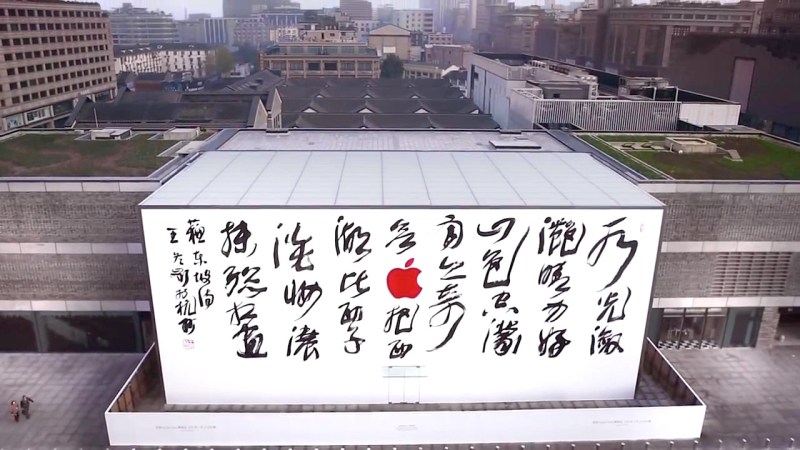
It has been an epic few months of localization activities for Apple. Recently they have opened five new stores timed right before the Chinese New Year. Four of the stores are in brand new cities for the brand including Zhengzhou, capital of central China’s Henan Province, West Lake in Hangzhou, Zhejiang Province. In each location, they have strategically partnered up with local artists such as Wang Dongling and painter Yangyang Pan to co-create signature murals inspired by each city for the local store.
The TV commercial for Chinese New Year has been met with mixed criticisms. Directed by Ann Hui, best known for her films surrounding the topics of social issues, and cinematography by Christopher Doyle, a key collaborator in many films by Wong Kar Wei. However, you can hardly trace their signature style in the production. One of the main reasons, perhaps, is because they had to follow the tight guidelines imposed on the production – it has to be “consistent” with the global version. The story bears an almost identical storyline to a commercial entitled “The Song” released in the United States over the Christmas season in December 2014.
US “The Song”
China “Old Song”
Even though it is by large a just a localized version, but at the very least, there is a strong and relevant proposition. The storyline cleverly positions the brand being the bridge between the younger generation and the old, and technology plays a role in connecting the emotions across generations.
Different brands tend to adopt a different approach to localize brand messages for local market. In the old model, creating the localized version often involves so many levels at the client side. Depending on the category of the product, it could involve anyone from the local marketing team, the regional marketing team and of course ultimately the global brand team. During the process, any form of innovative thinking will be filtered, reduced, modified, tweaked, abandoned, shot down, reinterpreted or misinterpreted.
Any creatives who had worked within international network agencies on global brands will know the challenges. Fortunately, some global brands are now doing it differently.
Apple now adopts a centralized approach – global ideas being conceived centrally, while implementation and production being done locally. Local content are developed following the global guidelines. Pepsi has adopted a more locally driven approach, leveraging current consumer trends that resonate well in the local market. While brands like Microsoft, they have established processes such as “global-readiness audit” to make sure the ideas and executions can travel well.
No matter which strategy you decide to adopt, one thing is for certain – if you want a cohesive global brand at all, you do need to think global at the time when the idea was conceived. The key to success is to create a truly global platform, which could be so fluid that it allows local interpretations without losing its integrity.
Most global brands prefer the 80-20 ratio of global-local content – to adopt 80% of the content centrally and globally, and allow local market to reiterate and adapt 20% of the content to enhance local relevancy. I personally advocate the 70-20-10 model in which 70% of efforts focus on delivering quality global communications riding on universal truth, 20% on pushing the boundaries to contextualize it with local nuances, and 10% on ideas and approaches which are unproven but could transform the marketplace in each local market.
Which model works best for you highly depends on how you structure the global-local team, and where you put the right kind of resources.
It’s also not easy to motivate creatives to get all excited to work on adapting global ideas, but you can create the space and environment to allow creativity to grow. Here are a few tips:
Human insights trump cultural ones. Avoid merely dressing up the global ideas but rather go deep into the reasons why, because that’s what true consistency is all about.
Nothing should stop you from creating something that is uniquely local; using very native expressions as long as underlying it there is a meaningful concept that everyone understands.
Construct a platform that local teams can “build on it” fluidly and not wasting their time to think of how to make it work.
Give anyone on the ground the tools and resources to thrive in scale. Be brutal in keeping the platform intact and trust your own instinct.
Consensus is not about everyone agreeing, it’s about everyone being heard and the rallying around the best answer. Never go for the lowest common denominator.
You can’t tell creative people to be creative, but you can let them.



 Louie Chow
You must be logged in to post a comment.