There has been a growing desire among brands to take a political or social stance in their campaigns.
Marketers feel that connecting the brand with relevant causes and messages not only is their duty, but as their product interacts with millions of people every day, they believe that they are in a great position and scale to positively change the world.
As creatives, our role is to help brands to identify the right and relevant connections and communicate that with authenticity, and in the right tone.
In fact, I have always made a point to dedicate a small portion of my time for any client I work with to help connecting them with meaningful messages that do good in the world.
But identifying the right connections between a specific purpose and the brand is not easy. Without a credible history of advocating a certain cause, brands will only appear as opportunists.
Another key issue is the choice of media. Message with a purpose do not always fit into the traditional media format where it’s more a one-sided communication and not a dialogue with consumers. With limited length, lack of context or limitations in square inches, traditional media also often force brands to over-simplify or over-generalise their messages.
Nevertheless, we should continue to encourage brands to have a purpose, and we should also help to make sure that it aligns with the brands’ values, with messages that have been carefully crafted so they appear in all the right tones and play the right role. We should remind brands that they need to remain humble and wise and encourage conversations and inspire people rather than adopting a didactic tone.
Last but not the least, be sure to make it a long-term commitment, and not just blindly following what’s been trending.
I have gathered below some of the examples of brands investing in a relevant cause that engages with consumers. Whether they have been executed well or not? I like to hear what you think.
I also like to hear if you have any examples from local brands that had successfully achieved similar goals.
Gillette “The Best Men Can Be”
The brand attempted to take an ancient and highly distinctive slogan “Gillette, the best a man can get” and revitalise it for a new era. The film calls on men to improve themselves by standing up against bullying, sexism and harassment.
Volvo “Defiant Pioneers”
In 2018, Volvo partnered with Sky to produce a short film series entitled “Defiant Pioneers”, exploring the remarkably resilient recesses of the human mind. Chapter 6 of the series is a film called “Unseen Ocean” in support of the fight against plastic pollution in our oceans. In 2019, Volvo sustained the message and released a children’s book of the same theme. The book is available on Amazon and all proceeds will go towards City Kids Surfing, the non-profit founded by primary school teacher Tom Franklin, who featured in Volvo’s “Unseen Ocean” videos.
Heineken “Open Your World
The Heineken’s “Open Your World” campaign challenges Brits to break down barriers and find common ground with others who have opposing views.
Nike “Dream Crazy”
Nike launched “Dream Crazy” campaign to celebrate the 30th anniversary activity for the “Just Do It” campaign. The film features athletes including tennis star Serena Williams, American footballers Odell Beckham Jr and Shaquem Griffin, skateboarder Lacey Baker and the controversial Colin Kaepernick.
Nike “Dream Crazier”
Nike’s answer to the follow up on the “Dream Crazy” campaign. It features a voiceover by Serena Williams and celebrates female athletes who have broken barriers.
The Body Shop “In Our Hands”
At the start of 2019, The Body Shop is putting “activism at the heart of its brand strategy”and turn its stores into “activist hubs” and attract more visitors to its shops.
Lush “Spycops”
In 2018, Lush launched the campaign, promoted using the hashtag #spycops, with Lush storefronts decorated with fake police tape emblazoned with the slogan: “Police have crossed the line.” The brand claimed that the campaign had a specific aim to make changes to the undercover policing inquiry, and to address “a controversial branch of political undercover policing that ran for many years before being exposed.”
Dove
Dove’s launched “Crown” in partnership with Kelly Rowland, at the GRAMMY Awards in 2019. The music video centred around self-esteem and confidence.
Vivienne Westwood
Vivienne Westwood has long stood for what she believes in over the years, from green energy to freedom of speech to anti-fracking, and this was one of the many manifestations of the campaigns she involved in.
When it comes to building a global campaign, most people will naturally think of visual and copy content – expressing the universal truth with locally relevant images and articulating the global messages with copy that resonates with the local audiences. But telling the brand story isn’t just about what images and copy, an aspect of a global campaign that not many people invest in is how the brand “sounds”.
I am not referring to designing just a sonic element or trigger that appears in the campaign – the Intel’s “Bong”, the Nokia’s “Grade Vals”, or Motorola’s “Hello Moto”. These are valuable addition to the execution that could add memorability and longevity to a campaign, but they are not enough to help communicate the emotional side of the brand message. Consumers have also entered into a truly connected world where the use of sound cohesively across all touchpoints – online, offline, events and a diverse form of customer interactions. The sonic branding has to act as the glue for communications across time, territories and touchpoints, locally and globally.
The recent manifestation of the HSBC’s “Together We Thrive” global platform perhaps have done just that. A series of commercials have been launched communicating the message of “shared prosperity” (inspired by the Chinese name of HSBC 滙豐) and the diverse nature of the brand, building on the visual identity that the outdoor campaign kicked off last year. To allow the core brand message to be flexed in each local region, a bespoke piece of music has been composed, created by Jean-Michel Jarre, that allows endless local interpretations expressing intricate nuances.
Orchestrating a global campaign requires great leadership and vision from the top, and complete collaboration at the local level. Music can be a shared “language” that everyone can contribute and build on.
On an execution level, music, rather than just an add-on to an idea, can also become a platform to support multiple activation between customers and the brand. I am looking forward to seeing how this will develop in the coming months.
Advertising is a reflection of our times. It always has been.
Advertising of brands, like music and movies, can be a social message in itself. It influences how we look, what we eat and sometimes how we see ourselves.
So when brands join force with another global and cultural phenomenon, such as sports, it can be even more powerful.
Brands want to be more “human”, and are a lot more open-minded to have a point of view. They understand in order to do this genuinely they need to allow people to have a voice.
Athletes understand their roles in the society and are more authoritative than ever to choose what brand they like to use as a platform to allow them to have a voice, and represent their values.
But in a commercial world, brands have a lot to be accounted for.
Brands have every pressure from the shareholders to invest only in messages that guaranteed sales growth.
Brands have every right to avoid associating with sensitive political issues.
Brands have all the reasons to communicate a message that appeals to “everyone”.
Thank goodness Nike is not such a brand.
The recent Nike campaignmakes no direct reference to any political viewpoints, but by featuring Colin Kaepernick (among Lebron James, Serena Williams and a slew of other athletes), the association to his protest against racial injustice, and decided to kneel rather than stand for the national anthem before a 2016 National Football League preseason game is clear.
What’s so compelling about the Nike message is not because it’s charged with one of the most sensitive political messages at the moment, and confronting face to face with one of the most controversial leaders in American history, it’s the pure fact that this is so true to what we know about the brand – someone who has the courage to speak his/her mind, and giving people of any background the space to expression theirs.
Not every brand can do this though. Any brand who hasn’t got that long established history of credential and integrity, will come out feeling sheer opportunistic.
The clever approach of Nike is that it does not have to express a single point of view but just create a stage for the broad range of people to express the breadth of their standpoints. In the process, bring people of many different backgrounds together.
It makes the brand feels more human, an advocate of freedom of speech rather than siding with one point of view.
True, after the news went viral, it pulled waves of both support and backlash, even boycott. The brand’s shares dipped in reaction to the news. But on the other hand, the campaign also received millions of dollars of media exposure. Perhaps all these have fulfilled the brand’s calculated cost benefit analysis, in communicating the message of an inclusive world for all.
Even if some people don’t agree with what you are saying, they will appreciate that you have the courage to say it and speak up.
Perhaps it’s really time for brands to believe in something, even if it means sacrificing everything.
When I started writing this blog I asked myself what it should focus on. Should it be about branding – adapting the brand identity, developing the Chinese brand name (from the legal entity name to the much more complex consumer- facing naming architecture)? Should it be about product development strategy – adapting the product from the ground up to fit the market, and consumers’ lifestyle and aspirations, as well as reflect the competition? Or should it be about making marketing content fit the unique media landscape with specific local brand messaging and content strategy? And what about the more operational side, like establishing local partnerships, sales channels and even recruiting local talent?
The truth is, when you’re marketing a brand outside its home country, you face all sorts of challenges – and they’re all intertwined with each other. And nowhere is that more true than China.
In all my experience of adapting global brands for Chinese consumers, I can’t think of a single example where it wasn’t necessary to change positioning and marketing mix in a big way. I’ve transformed product positioning of consumer products like Kit Kat from a self-indulgent treat to a sharing sensation among friends. I’ve searched far and wide to find spokespeople for global brands like Lux and American Express who can truly resonate with a local audience and still stay in sync with the essence of those brands.
Of course, none of this precludes the eternal debate about how feasible or desirable it is to be globally consistent. Or the need to remember that ‘consistency’ doesn’t equal a one-size-fits-all literal interpretation of a tagline. How should HSBC speak in the same tone as the rest of the world as ‘The World’s Local Bank 环球金融 地方智慧’ (HSBC had changed its global brand platform to ‘World’s Leading International Bank’ since 2011) but express consumer benefits in a really direct way? How should a fast-moving fashion brand like H&M stand out by toning down its price point and promoting its trend credentials instead? How do British brands like Pret A Manger find their purpose and emotional attachments in the context of the local culture, so they do more than just sell food?
To make brands relevant and trigger loyalty that adds up to a sustainable price premium, global brands have to get in step with local cultural imperatives and operational realities. At the risk of over-simplifying or making sweeping generalisations, here are some thoughts about the differences they can expect to find in China.
Are you talking to me?
Language is perhaps the most tangible. One of the first tasks of the marketing plan is to develop the brand name (an equivalent of the global brand identity). That’s before you even start to develop and adapt the brand proposition, key messaging and overall content. To succeed, you need to understand both global intent and local context. If you blindly follow the conventional idea of consistency and ignore local nuances, you’ll almost certainly fail.
When it comes to Chinese names for global brands, going for the safe option of the phonetic equivalent will end up sounding like everyone else. But over-rationalizing could leave you with a name that reflects the marketing brief rather than sounding like something born natively for the local market. In 2017, Airbnb relaunched in China with a new Chinese brand name 爱彼迎(pronounced ài bi yíng) that means ‘welcoming each other with love’. But reaction has been mixed, with many already comparing the company’s strategy with other brands who have failed in China. According to AdAge, Airbnb spent a year deciding on the Chinese characters that made up the name, with brand consultancy Labbrand consumer testing over 1,000 possibilities. Yet the result has been widely criticized in the press and on social media.
Airbnb’s launch campaign in China
Names can be very subjective. So use clear criteria to help you choose. Once you’re down to a shortlist, research can be useful. Carefully testing names with your target audience will help you gauge appeal and weed out any unanticipated negative reactions. Research can’t tell you everything, and it shouldn’t be the only thing you use . Nor should it stop you taking calculated risks or simply trusting your instinct. But it does help guide decision-making and build consensus among your stakeholders.
It’s not just what you say, but how you say it
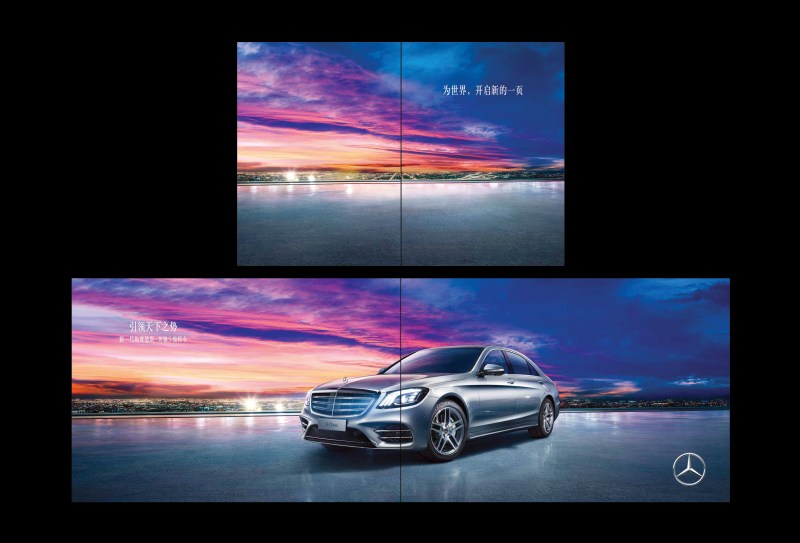
Another big difference for brands in China is how to talk about benefits. They need to be prominent, but brands also need to talk about what they mean for the greater good, not just the individual. , The western idea of reinforcing ‘what I want, and how I feel’ irrespective of societal consequences doesn’t work. So the brand communications of Holiday Inn Express, an InterContinental Hotels Group brand, emphasize ‘smart choice’ rather than just ‘efficiency’. Johnnie Walker’s ‘Keep Walking’ proposition that emphasizes endless striving for personal progression has to be ‘shared’ and ‘recognized’ among peers. Mercedes Benz, one of the best-selling brands in China, elegantly fused its global positioning with a Chinese declaration of ambition in a recent campaign, executed as a six-page gatefold ad with the headline ‘For the world, we open a new page’.
Mercedes Benz shows its presence in the Chinese market through heavy advertising spend, including this gatefold spread launched in January 2018.
It’s not just how you say it, but where
Comparisons between Western markets and China often focus on the difference in internet penetration and smartphone adoption. But the popularity of smartphones has increased dramatically in China. And digital platforms are evolving fast to become part of Chinese consumers’ daily lives.
China’s internet economy has now raced ahead of the West’s, making China a truly mobile-first market. Besides the sheer size that goes with a billion-plus population, it’s also ahead on features. Consumers in China can now use the internet, specifically WeChat 微信(Pronounced Weixin in Mandarin), to do an extraordinary number of things. Apart from messaging (the key feature when the brand launched in 2011), it’s evolved to include voice and video calls, integrated news and public service announcements, gifting, ride-hailing, food delivery, doctor/dentist bookings, and even visa applications. It integrates social media, search and e-commerce, all inside one walled garden. A recent official report estimates that, as of September 2017, an average 902 million users log in to WeChat daily, up 17% year-on-year, and send 38 billion messages.
WeChat’s reach is appealing for global brands. But it also makes it easier to do business in China by bypassing stringent licence requirements. On the other hand, its multi-disciplinary nature makes it incredibly challenging to create appropriate content fundamentally different to the fragmented content in the West.
As a start, an official presence on WeChat can help global brands control their marketing message in China, create personalised interactions with their audience and directly manage customer relationships through the app. All of that could have a huge impact on brand loyalty if they handle it with care. Chinese consumers can discover and find out about brands and their products, interact with trusted friends and buy items all through one platform. So content needs to fulfill long-term brand building objectives: bridging online and offline experiences, creating a distinctive tone of voice, acting as a customer service with social listening functions, and creating a seamless buying experience.
WeChat is extending its reach to a version for business communication called Enterprise WeChat. Among other things, it lets employees track their annual leave days and expenses, and clock in and out. To underline the scale of adoption, DiDi ChuXing, the latest brand success in China, has encouraged its 7,000 staff to communicate almost exclusively on Enterprise WeChat.
Don’t just spot differences, celebrate them
Chinese consumers are increasingly sensitive to how global brands behave in the market. Brands that celebrate local culture while skilfully infiltrating their global essence can win their hearts, especially if they bypass one-size-fits-all global consistency to craft a local tone of voice. Global brands need a ‘first follower’ in China to localize and lend authenticity to the brand. In 2017, Burberry chose China’s pop, movie and fashion sensation Kris Wu as their first local Key Opinion Leader (KOL). That opened up China’s millennial market, giving the brand social currency to let its message spread on the many social commerce platforms.
Another powerful tactic is to allow local interpretations of global ideas. In December 2017, Adidas re-imagined its ‘Original is never finished’ creative platform with a new set of creators from all over the world including Kendall Jenner, James Harden, 21 Savage, Young Thug, and Eason Chan. It proved that when you create freely, the outcome will always be original, globally.
The global edit:
The Hong Kong edit:
The Korean edit:
China is complicated. Economically, socially, culturally and demographically, not to mention politically – whichever way you look at China, it bears little resemblance to the West. And it keeps getting more and more complicated. So one blog will never cover all the golden rules on marketing there.
There’s no single route to success when launching your brand in China. But it’s safe to say you need a plan that works for your brand and product category, and your ambition in the market. There are also other issues, like product extension, local legislation, censorship, and product safety (especially for food brands). All these steps are essentials you’ll have to consider before developing any marketing strategy for China.
Note: I have contributed this blog to VengaGlobal and Gala. An edited version of it had appeared on my LinkedIn profile.
Coca-Cola recently announced their “One Brand” strategy. A series of changes affecting the advertising campaigns for the portfolio of brands, and the detail packaging design alignments were announced. This shift from brand-specific advertising will see the brand uniting all four distinct brands – classic Coke, Diet Coke, Coke Zero and Coke Life, logically under one master brand marketing banner: The Coca-Cola family. The objective is to drive synergy across the portfolio.
The overriding tactic is that Coca-Cola is the only thing the company will position and give meaning to, and underneath it will sit different product variants. Each variant will be equal in the overall portfolio but “won’t have a meaning attached to them.”
Coca-Cola continuously ranked at the top in the world’s global brand rankings over the years. In 2013, according to The Best Global Brand from Interbrand, it slipped from the top spot after 13 years to third place. Perhaps it was the “wake up call” for the brand. But was the dilution of brand strength really due to its diversification into campaigns for individual product variant?
The strategy was an outcome of recent consumer research, which revealed that 5 out of 10 of consumers don’t know what differentiates each product in its portfolio. For example, people don’t know that Coke Zero has no sugar and no calories. Consumers are also unclear about the different between Coke Zero and Diet Coke.
Coca-Cola considered the company’s efforts to build personality behind its individual brands has become an obstacle to consumers’ understanding of the products.
Building meaning in the communications will not affect consumers’ understanding of the product. A brand under the brand halo itself could become an identity in its own right, as opposed to just being seen as one of the variants. I believe the heart of the matter is when the “meaning” is not connecting with what the product represents, then it ends up a waste of effort.
Product differentiation is increasingly hard for brands operating under portfolio brand strategy. From FMCG brands to service brands, the fragmentation of brand messages often causes confusion in consumers’ mind. When HSBC launched the “Personal Economy” platform for their “Premier Account”, was it distinctive enough to help consumers to clearly differentiate among the “Premier”, “Advance” and “Business” accounts? Do consumers clearly recall the commercial starring Jude Law was for Johnnie Walker’s Blue Label? What about the differences among Red Label, Black Label, Gold Label Reserve and Platinum Label? How does the whole range connect with the brand message of “Keep Walking”?
The list goes on.
In the case of Coca-Cola, should the “Open Happiness” platform be given an even bigger playground with universal appeal? Or should it be changed to a more rational statement such as “Choose Happiness”?
The “One Brand” strategy will be executed on campaign level and on product level, and will affect agencies working within the framework. Some of the changes can be summarised as:
The newly evolved brand tagline “Choose Happiness” will be launched in Great Britain before moving to the local markets globally. It will be hugely interesting to see how the tagline could be adapted.
New brand campaigns will focus on the brand idea of happiness and optimism and will roll out in Great Britain, Ireland, France, Belgium, Netherlands, Nordics and Spain.
All advertising campaigns from May in Northern Europe will feature all four products, with the lower and no sugar Coca-Cola variants presented in the final frames of all Coca-Cola TV ads.
Although all four variants will feature in future campaigns, Coke will be able to spotlight or “hero” whichever variant is relevant to the campaign, through visual representation and strategic executions.
Individual campaigns for individual product variant will be scrapped. That includes some of the newly launched campaigns such as “Regret Nothing” for Diet Coke.
Brand message will suggest there is a “Coca-Cola to suit every taste” by more clearly communicating product differentiation rather than personality – to enable consumers to make informed choices.
On the product level, some of the strategic changes include:
New packaging will see each variant being given the “same design” and set of characteristics, such as the iconic Coca-Cola script, ribbon and layout.
The “Cola-Cola” trademark will be made larger and more visible, with more presence of the iconic red colour.
Text will also be added to the front of Coke Zero, Coke Life and Diet Coke to enable consumers to better understand the range of products and the distinctive attributes of each. On the front of Coke Zero cans, the descriptor “zero sugar – great Coke taste” will be strategically repositioned in the foreground.
There will be an introduction of colour coded front-of-pack labelling showing fat, saturated fat, salt, sugar and calories.
All these design changes are aiming to create a more visual “common identity” across the brands. The more unifying set of characteristics that the brand shares.
We are already seeing some of the new ads hitting major touchpoints.
In brand advertising, the big change can be seen in the latest global print campaign starring Marilyn Monroe and Elvis in celebration of the 100 anniversary of the brand’s contour bottle.
In product-as-hero communications we see a deliberate attempt to present the range in equal light. But will the execution help the different product characteristics come to life when “product truth” are being communicated in a much more straightforward way? Or will the lack of “meaning” turn the ads into something better fit for corporate presentations? The result is yet to be discovered.
New strategy brings new collaborations
At the end of the day, any new strategy won’t succeed without collaboration across the board. Here are some of my predictions:
Communicating product truth for each product variant is important but cannot be done without the support of a meaningful brand message. Product message needs to be connected with the brand’s umbrella message.
It’s not a choice between logic and magic, but a balance.
On a positive side, I think the strategy will be instrumental in paving the way to a more efficient and single-minded global campaigns. But this will only be achieved through rethinking how the brand campaigns are created and implemented across each product in the portfolio.
Doing it well, it will allow the brand to innovate into the future with a single voice, and do it in a way that doesn’t require the brand to invest in creating a new entity every time – a much more flexible approach in accommodating product manifestations.
I can also see there will be a need for tighter collaborations among the creative agencies handling different channels. Leadership will probably be driven centrally, where collaborations among agencies are encouraged and well facilitated.
The lead creative agency, on the other hand, needs to spearhead the development of the big brand idea, and create a strong creative platform on which messages of individual brand in the portfolio can build on. More important, creatives need to think of media-neutral platforms and not media-centric ads. Each agency needs to put their egos aside and completely understands the DNA of an idea and be able to expand it beyond any boundaries of a specific media.
For a global brand with local connections and meanings, any new creative platform needs to offer each country an opportunity to interpret its own “moments of happiness” and the brand’s role in those. The brand should tap into local talent to add to the effort to their marketing programs through joint global initiatives.
I stumbled upon an image on facebook recently and it had stuck in my mind for a long time. It’s a facebook page of InterContinental Hotels where guests post snapshots of the hotel from all over the world. It’s a fantastic collection not because it is completely from the eyes of the consumers; it also illustrates one interesting thing – the hotel looks and feels so differently in each market.
This got me thinking…how does brand consistency apply in this context? Is consistency really relevant after all? Or perhaps we need to redefine the conventional definition of consistency?
What about global brand guidelines? We often hear branding specialists emphasize that in order to maintain global brand consistency, local markets need to be provided with over-arching guidelines about presentation, logo use, images and tone of brand messages, often in a manifesto or marketing book. However, many of these brand guidelines are over simplifications or generalizations that often have not allowed the breath of thinking.
I think consistency is an attitude. It’s more about the ‘how’ than ‘what’.
Intelligently local
As brands become more national, multinational or global, they realize that not all the consumers in each market have the same needs. The need for global brands to be transformed and make sure they are locally relevant is increasingly important. In the travel industry, for example, hotel brands have been increasingly adapted to the local needs.
Accor has revamped its Grand Mercure brand in China, offering products and services tailored for local clientele, in a move aimed at taking advantage of the booming upscale domestic travel market.
Grégoire Champetier, chief marketing officer of Accor said “Our clients are now expecting brands capable of understanding the diversity and the complexity of their identity.”
The re-engineered branding for Grand Mercure, referred to in Mandarin as Mei Jue (美爵), was unveiled at the inauguration of Grand Mercure Shanghai Zhongya, the first hotel adapted to the new positioning. The group’s nine other similarly branded properties in China are due to adopt the new identity.
In Shanghai, employees will be conversant in the local Shanghainese language (a dialect that is class-defining in mainland China), and guests will be welcomed by staff wearing Qipao, a traditional evening dress (Think Maggi Cheung in the Mood for Love).
All local staff will be identified with name badges bearing firstly Chinese characters, followed by a pinyin equivalent enabling them to use their given names rather than adopting foreign equivalents.
Other signature services include daily Tai chi lessons, and complimentary head and shoulder massages (Chinese style presumably) for guests staying on premium floors.
The Grand Mercure brand provides Accor with a fresh platform for organic upscale expansion throughout the country. The opportunity for organic growth in the upscale hotel segment in China is one of the largest in the world. Accor’s tailor-made Grand Mercure product has already garnered great support from hotel owners. Accor currently operates 10 Grand Mercure hotels in the country. Accor has confirmed commitments for 10 additional hotels, and announced that it will expand its network to around 65 hotels in tier 1 to tier 3 cities throughout China by 2015.
Authentic global
The concept of globalization often carries a dose of negativity. By definition, globalization means the ‘process by which the peoples of the world are incorporated into a single world society’, which indicates the process of standardisation. However, in an increasingly interconnected global economy, many of us cherish our local roots. Some global brands understand that and promote ‘now localism’ in their brand strategy.
Hotel Indigo is what IHG considered to be their nearest to a non-hard brand.
As their CFO of EMEA and head of development for Europe for IHG, Paul Edgecliffe-Johnson, once said “A good brand is one that does a lot of research into what consumers want and designs something around that”. In fact they have put this in practice and bring in the feeling of the locale wherever they go. For example in Liverpool, the hotel focus on the music scene, in Shanghai it captures a strong Chinese-feeling.
Bart Carnahan, senior VP for acquisitions and development of Starwood Hotels & Resorts Worldwide once commented on the pros and cons of hard branding versus soft branding: “St. Regis for us is hard-branded—you know what you’re getting”. Luxury Collection is getting close to these white brands, it has some core consistencies throughout those brands, but it gives more breadth to owner developers, so it’s not so rigid. Carnahan said Starwood’s upscale brands have to have local designs to get that eclectic local feeling and the company wants some of the luxury brands to be.
Not just local, it’s your neighbourhood
Going one step further, the notion of ‘place’ is such a core of the proposition that certain brands has gone all out to adapt to local market needs. Statbucks is one such brand. In Seattle, 15th Avenue Coffee & Tea looks nothing like a Starbucks. But, this new café, named after the street where it is situated, is a Starbucks. Starbucks has decided to un-brand it’s newest location in Washington DC. By featuring local entertainment, sourcing from local bakeries and donating leftover food to the local parish, these new un-branded cafés aim to integrate themselves into the fabric of the neighbourhood.
Consumers are turning away from the allure of globalization and massive brands for the comfort of localization. In the US, we stand poised to see the resurgence of neighbourhood. How can your brand capture local character and appeal to consumers’ by providing them with a greater sense of identity and belonging?
Here, I am leaving with you some food for thoughts:
What consistency means in global brand management nowadays? Does it need to be redefined?
If brands need to be localized, what are the impact in the process of creating and implementation of global campaign?
If one-size-fits-all marketing tactic does not work for certain product categories, what are the implications of adapting global ideas for local markets?
Apart from a few obvious global giants, few brands establish dominant positions in multiple markets. Often this has become one of the main challenges for brands to create one single global creative platform.
There are a number of reasons behind it. Different perception and taste of the product is one, what I call the ‘marmite effect’. Or the product could simply be reaching a totally different product life cycle in each local market. Orangina is one such example.
When Miss O meets Tora-san
In France, the brand began its production in 1963 and has been so established that, arguably, it has become a lifestyle brand. In its popular advertising featuring the classic Orangina Rouge to the controversial ‘furry animals’ campaign back in 2008 through to the most recent ‘Miss O’ creative platform, it’s all about creating buzz and keeping the brand fresh and current in the mind of consumers. It’s what’s outside that counts!
In the new series of spots by Fred & Farid Paris directed by Joseph Kahn, the lady wolf is portrayed as a heartbreaker, in “Working late” she lies to her wimpy boyfriend and then in “Dump”, she breaks up with him in a very public way. The work, centred around the wolf, who is Miss O, asks you who really is the boss when it comes to relationships.
The local culture also provides a perfect playground for such creative platform to flourish, share and engage. The tagline “C’est qui le sexe fort?” (creatively adapted as “Who is the boss” or literally means “Which is the strong sex?”). Interestingly, the French consumers with GSOH are not steered to take the message literally, and the creative idea was instantly recognised, accepted and embraced.
On the other side of the globe in Japan, Suntory acquired the Orangina brand in 2009 and the new-look Orangina replacing the classic pear-shaped bottle was just launched in March. As a relatively new brand in the market, being French has its advantage. The recent ‘Toro-san’ campaign featuring Richard Gere rides on that ‘foreignness’ and was distinctively designed for that market.
In the launch commercial, Richard Gere appears as Tora-san, the lovable ‘loser’ in Shochiku’s very popular 48-film series of Japanese comedy movies entitled 『男はつらいよ』(It’s Tough Being a Man). Not only is he a contemporary adaptation of the original character played by Kiyoshi Atsumi, the commercials also use the same iconic music “Otoko wa Tsuraiyo” from the series.
The original Tora-san in 『男はつらいよ』:
The underlying message is that the brand is a western idea adapting within the framework of the Japanese culture. By riding on the character of Tora-san who is famous for being a bumbling Mr. Everyman, gives the brand personality a distinctive western dimension.
George Field wrote in his book “From Bonsai to Levis” (1983), and commented that in Japan culture, contrary to the stereotype, the woman is the boss (in the context that Japanese women control the purse strings in the family and are well positioned to occupy the seat of power).
There is an intriguing irony between the dominating ‘Miss O’ and humble ‘Tora-san’ here. Though I have a feeling that it is just a happy co-incidence, I cannot help but imagine what if ‘Tora-san’ meets ‘Miss O’, could that be a marriage made in heaven?
Could that be a cross-border joint production and creative adaptation?
One might argue that going for a completely localised approach, it means that it will be a long way when Orangina can create a truly global brand that captures a common language as in the case of some other globally aligned beverage brands.
For the time being, the brand may not be able to take advantage of the costs efficiency enjoyed by creating a centralized global idea that many marketers aim for, but they certainly give the brand an opportunity to grow with the local market at the right time, in the right place. This also reinforces the belief that there is no single, optimal answer to the question of how to manage a global brand.
It’s 9 pm and I have just finished skyping some of my creatives in Russia to double-check on a heated debate happening in the world of global marketing. I wanted to be absolutely sure before I add to the rather controversial discussion.
On 21 March, Kraft announced that its new global snacks company will be named Mondelēz International. (Please note there is a crucial macron over the second ‘ē’ – which a lot of journalists did not include, in fact, neither does it appear in the body copy of the press release from the official Kraft Food corporate site.)
The company said the name (pronounced mohn-dah-LEEZ) was inspired by the suggestions of two Kraft employees. It is intended to evoke the idea of a “delicious world” as “monde” is derived from the Latin word for “world” and “delez” as an expression of “delicious”.
Jez Frampton, global chief executive officer of Interbrand Ltd., talked about Kraft Foods Inc.’s name change to Mondelēz on Bloomberg Television, referring to the move as a clever idea.
Here’s where the debated started. After the announcement, it was quickly reported that when pronounced as “mohn-dah-LEEZ” the name immediately drew feedbacks from Russians. Apparently, it means something else to Russian speakers, say those fluent in Russian slang (when pronounced, it sounds like the Russian slang for a sex act). After checking with a few Russian copywriters and they all confirmed that people will certainly make fun of it; they also believe that the male audiences will likely be the ones to be starting the joke.
Back in August last year, Kraft already announced officially that the company would be splitting in two by the end of 2012. And like any creation of a new name, it had gone through a long process. According to Kraft, they have crowdsourced ideas from employees, and more than 1,000 participated, submitting more than 1,700 potential names. The inspiration for Mondelēz came from two employees, one in Europe and another in North America. From what it sounds, it was probably the result of a blend of two ideas.
Kraft also commented that they have properly vetted the new name. According to John Simley, they have done “extensive due diligence in testing the name…that included two rounds of focus groups in 28 languages, including Russian. We determined misinterpretations in any of the languages to be low-risk.”
Many people blamed it on the language issues, and indeed quite a few blunders like this had happened in the world of international marketing and branding. I recall here just a few examples:
When Volvo first came to America, the brand also drew controversy because of the similarity between the Swedish car manufacturer’s name and female anatomy
General Motors had to change the name of its Buick LaCrosse sedan in Canada after it found that the word LaCrosse is slang for masturbation in Quebec
On Bugati‘s website in December 2010, they have advertised a car available in “rape yellow” which was the result of French to English translation error of “rapeseed plant”
Naturally, we question why the problem was not spotted within a big multinational company with multi-cultural staff? What about the creative or brand agency who had provided consultancy service to the client? What about the research company who orchestrated the focus groups in 28 languages? Did they do the research locally?
I believe the reasons are sometimes more complex.
Even if they have conducted naming research, my speculation is that due to the confidential nature of the research, they may not have revealed the full context of the name, so the respondents only were able to respond to a very tightly defined definition, or the questions were set in such ambiguous way that people could not give the feedbacks judged from the whole background.
Another possibility is the reasons behind the name change often could be complex and all the stakeholders contributed in the decision process, which often ends up in a ‘mish-mash’ of messages. A small twist to a name often will end up a disaster. Not every name change could be as lucky as and managed to conquer the challenges like Accenture (formerly Andersen Consulting) or Altria Group Inc. (formerly Philip Morris).
Let’s just take a look at some of the recent name changes and their rationales behind it, and you’ll know what I meant.
“The beginning of the name connects the new company to Abbott and its heritage of pioneering science. The ‘vie’ calls attention to the vital work the company will continue to advance to improve the lives of people around the world.” According to Richard Gonzalez, CEO of the drugs business.
“When determining the new name, we thought of things like strong heritage, leadership, dynamic brands, bold growth, operational excellence and a great place to work…D.E Master Blenders 1753 captures all of those elements.” According to Michiel Herkemij, executive vice president and chief executive officer, Sara Lee International Beverage.
“As the current name would suggest, Corn Products make a number of food ingredients from processed corn, like starches and sweeteners. But the company also makes ingredients from tapioca roots, like starches that add texture to dairy products” According to spokesman Aaron Hoffman. And according to the CEO Ilene Gordon it will reflect a shift in business strategy, but it would better represent the company’s pallet of products.
Relaying on a name to encapsulate a huge ambition may well be one of the main reasons.
Whether the name Mondelēz will be under further scrutiny is unsure and whether the company will evaluate all the feedbacks from the public is yet to be seen. At the time of writing this, we understand that Kraft is also working with the creative firm Attik on a corporate identity for Mondelēz, let’s hope some magic could be done to rectify this situation.
Mother’s Day is celebrated on different days and dates around the world. But in almost every culture, mothers play an important role in the family. Brands understand that, and will take every good opportunity to win over their hearts.
In the Chinese culture, women often are the ultimate decision maker in anything related to the household. Here’s a brilliant analyses of this insight from Tom Doctoroff:
Despite Mao’s famous saying that women hold up half the sky, even “liberated” female consider their role inside the home paramount. In the West, working mothers struggle with balancing career and family satisfaction. In China, the battle is much less fierce; the kid wins, hands down…So, to bond with your female “head of the household” target, tell her she is really really needed. Without her, there would be no family harmony.
In America, mothers don’t really want to see the “perfect mom” in advertising. They consider that the image of perfection is frustrating to watch, rather than aspirational. Kate Reddy, played by Sarah Jessica Parker, in the movie I Don’t Know How She Does It only exists in fairy-tales. On the other hand, if brands portray the “real mom” image, it is too close to home – a reminder of the frustrations, rather than a positive view. However, one thing they have in common – they all want to see a positive image that shows the brand delivering a realistic improvement in their life.
In the Thai culture, where people in urban families rarely show their love to each other publicly, a commercial by DATC (see below) made it even more inspiring, and in a way, started a ‘movement’ in the local market.
From food, financial services, retail, communication products to public service; and from China, Thailand, Singapore, Brazil to the UK, this emotion works unfailingly. When executed well and honestly, the effect could be very powerful.
At the time when we celebrate Mother’s Day, I would like to share with you some of the commercials from different countries that capture this sentiment.
I also love to hear from you if there are any great campaigns describing the love of mothers that reflect the unique culture of your country.
▼John Lewis, United Kingdom
▼LamSoon, Hong Kong
▼DTAC, Thailand
▼Thai Life Insurance (Mae Toi), Thailand
▼TE AMO (I LOVE YOU), Brazil
▼thinkfamily.sg, Singapore
Note: This public service spot was directed by the award winning film director, Yasmin Ahmad.
▼Bud Light “Wedding Dress”
▼Oxo Cubes: Remember Preston
▼Calbee Cappa Chips: That’s Life
▼Heinz Baked Beans: Margaret
▼Tesco: Cheerful Sole
*Special thanks to Helena Rosario from Portugal and Nattavut Leekulpitak from Thailand who sent me their favourite commercials.
A few thoughts on adapting global marketing campaign had been brewing in my mind for a while.
It all started with the ‘T’ word
In the past 10 to 15 years, when brands started to go truly global, one of the key steps they had taken was to align their brand advertising to achieve synergy in every market they advertised. At the same time, they started to realise that translating the marketing message in foreign markets was no longer enough, that’s when ‘transcreation’ (in global campaign) came about.
That was the time when I was recruited by a London agency specialised in this revolutionary approach. I moved from Asia and joined the original visionary team that determined to make it happen. I started to leverage my creative agency background to build a network of creative writers around the world, expanding the company’s talent pool from just key European markets to pan European, Asia Pacific and beyond.
Nowadays, the creatives that I have handpicked, have collaborated with global brands across the whole industry and had become the early adopters of this discipline.
At that time I didn’t really refer the service as ‘transcreation’. I defined the approach the same way as any local copywriter creating brand stories for the local market – the only difference being the global idea formed the backbone of any creation.
In many ways, my philosophy has never changed.
What does ‘transcreation’ really mean?
It reached the point when more and more people talked about ‘transcreation’, and marketing agencies (even translation companies) started to reposition their services to match the growing trend, the true essence of the meaning had become blurred.
In previous blog posts I have already expressed my view on the many misguided definition of ‘transcreation’.
Many people over the years had attempted to define it, with little clarity.
In the world of global marketing, the term has been loosely adopted to describe the kind of adaptation work that adjusts to the culture of local markets.
Within the marketing implementation industry, the term had been used just because this is, up till now, how most marketers understand it.
In fact, I have always had a concern about how people actually understand it.
It gets a bit ‘cloudy’, and does not help in showing the true value of the work when it is being done properly.
If you think all it involves are avoiding all the cultural pitfalls in foreign markets – expressions that does not mean anything in a foreign market, colors that create negative connotation or customs that is frowned upon in a different culture, then think again.
Let’s take a step back and consider the brief origin of this term:
Transcreation was originally used to express a literary tradition of India especially after the emergence of modern Indian languages. It was used to describe the people oriented and the time oriented creative translations of the ancient Sanskrit spiritual texts. This term originally used by contemporary writers like P. Lal for his English translation of the Shakuntala and Brhadaranyaka Upanishad (1974), is applicable for the whole tradition of creative translation of great classics like Ramayana, Bhagarata and Mahabharata in the regional languages from Sanskrit.
The methodology of ‘transcreation’ all makes perfect sense until companies start using it as a fancy term without fundamentally understanding the true impact of the output.
Part of the arguments in the past on ‘transcreation’ was on cost savings – one ‘master asset’ to be used for multiple markets. This argument is also gradually breaking down with the introduction of smart production process and technique, and the costs of recreating asset could be substantially reduced.
And that’s the reason why I like to challenge it and rethink what’s relevant in the current global marketing landscape.
Is ‘transcreation’ the only answer?
I developed the ‘creative adaptation’ service for some of our clients just because of this. By approaching it pretty much the same way as in approaching a brief from fresh, but taking the global brand and platform as part of the backbone of the local execution. By thinking 360° and activate the ideas in all touchpoints relevant to each local market.
The only challenge is, the line is so fine that only when you involve in the creative process, you often find it difficult to distinguish the differences.
I believe it is also intensified by the growing popularity and importance of digital and social media, where local executions are often the more preferred way to execute the idea. Locally developed executions are beginning to challenge the integrity of the global platform.
I think it’s time we approach it from a fresh angle.
Enter Trans-origination
Rather than approaching it in the contrived and often tightly framed manner – i.e. based on a master source and ‘transcreate’ it by applying necessary adjustments and changes to make it suit the local market – we approach it the same way like the thinking process of ‘origination’.
Origination: The act of starting something for the first time; introducing something new.
Only when we stop just trying to ‘shadow’ the master source materials, will we be able to think out of the box like a local.
Part of the arguments in the past on ‘transcreation’ was on cost savings – one ‘master asset’ to be used for multiple markets. This argument is also gradually breaking down with the introduction of smart production process and technique, and the costs of recreating asset could be substantially reduced.
How to be a ‘trans-originator’
How should we approach ‘trans-origination’? Here are some tips:
Don’t get boxed in the literal context. Spend more time to identify the true universal truth and more importantly, what each market actually needs. The universal truth is more likely to be deeper than the copy message itself or just the ‘campaign tagline’
Understand the local market beyond just the confinement of the ad campaign in question. Consider every expression holistically – from naming through to corporate culture, from marketing communications to even model of after sales service – because these are increasingly important in creating total consumer experience.
Apply T-shaped thinking: if transcreation goes for the depth, trans-origination goes for the breath. Think about extending the campaign to media apart from the pre-determined channel of the ‘master asset materials’ – sometimes spending the resources to re-interpret it in a totally different media that works better for the local market will prove to be more effective and guaranteed better return of investment.
In a nutshell, don’t just do it, start asking why.
Some signs of the growing trend of ‘trans-origination’
Coca-cola’s ‘Open Happiness’ positioning was trans-originated as a social campaign in Philippines, a good-will ‘Make Tomorrow Better’ campaign in Egypt or as a fun-filled marketing stunt in America – all are designed to be the manifestation of the ‘happiness’ platform in a local context
Johnnie Walker ‘Keep Walking’ platform is trans-originated in the ‘Jonnie Walker House’ experience in China
Levis was trans-originated as a local brand dENiZEN primarily for China and will be marketed across Asia, transferring knowledge of the mother brand to a newly developed local brand
French fashion label Hermès trans-originated as a luxury brand Shang Xia for China in 2010
InterContinental hotel is going to trans-originated a new luxury hotel brand in China riding on the operation support of the master-brand but in a totally local brand identity
Less theory. More practice.
All the ‘T’ words that I have mentioned are not attempting to replace each other. They should be considered as different tools in a tool box – use the right one in the right time.
Trans-origination is not just a fancy term or an upgrade of the same service but a fundamental shift of thinking and approach in developing and adapting global marketing campaigns in the digital age.
For this reason, I think trans-origination™, is the future.
I like to hear your thoughts.
(No need to Google the term yet, cause you read it here first!)
Stop press: Just when I am writing this on my holiday I read that Starbucks will open its first coffee shops in India in August or September in 2012, and aims to have 50 outlets by year-end through a tie-up with the Tata group. With India’s strong tea drinking culture, I can see a perfect case for trans-origination in the brewing.









 Louie Chow
You must be logged in to post a comment.