Over the past year, Generative AI has blossomed into one of the most transformative technologies of our era. Its development has been nothing short of astonishing, sparking our collective imagination and prompting industries to reconsider their approaches. From the outset, it became evident that this technology wasn’t just a passing trend; it was a paradigm shift.
Generative AI, as a versatile general-purpose technology, has showcased its remarkable adaptability. Its applications span an impressive array of sectors, offering innovative solutions to age-old challenges. From healthcare to education, agriculture to retail, Generative AI has explored every nook and cranny, promising transformative possibilities in each domain.
Consumer adoption of Generative AI has been nothing short of spectacular. Within months of its introduction, we bore witness to the birth of the fastest-growing consumer application in history, reshaping how individuals engage with technology. Simultaneously, at an enterprise level, companies swiftly recognized the potential of Generative AI. Start-ups emerged, matured, and were promptly acquired, illustrating the intense competition in this burgeoning field.
My conversations with creatives and CEOs have painted a vivid picture of the divergent emotions surrounding Generative AI. Creatives have wholeheartedly embraced the new possibilities it offers, envisioning a future where AI collaborates in the creative process. In contrast, CEOs in global production agencies experience both excitement and caution, grappling with the transformative potential of Generative AI within their established structures.
Participating in an executive program on AI offered a unique vantage point to witness Generative AI’s impact across diverse industries. From healthcare to legal, education to agriculture, each sector approaches adoption and implementation with its own unique perspective and challenges. This diversity underscores the technology’s universality while emphasizing the need for tailored strategies.
AI Spring’s Key Moments (…So Far)
To reflect on pivotal moments in the Generative AI journey, I’ve compiled key events from the past 11 months or so. While these moments aren’t exhaustive and aren’t ranked in any particular order, they shed light on how various companies and industries, closely related to my own field, have harnessed the power of Generative AI to drive innovation, transform processes, and gain a competitive edge.
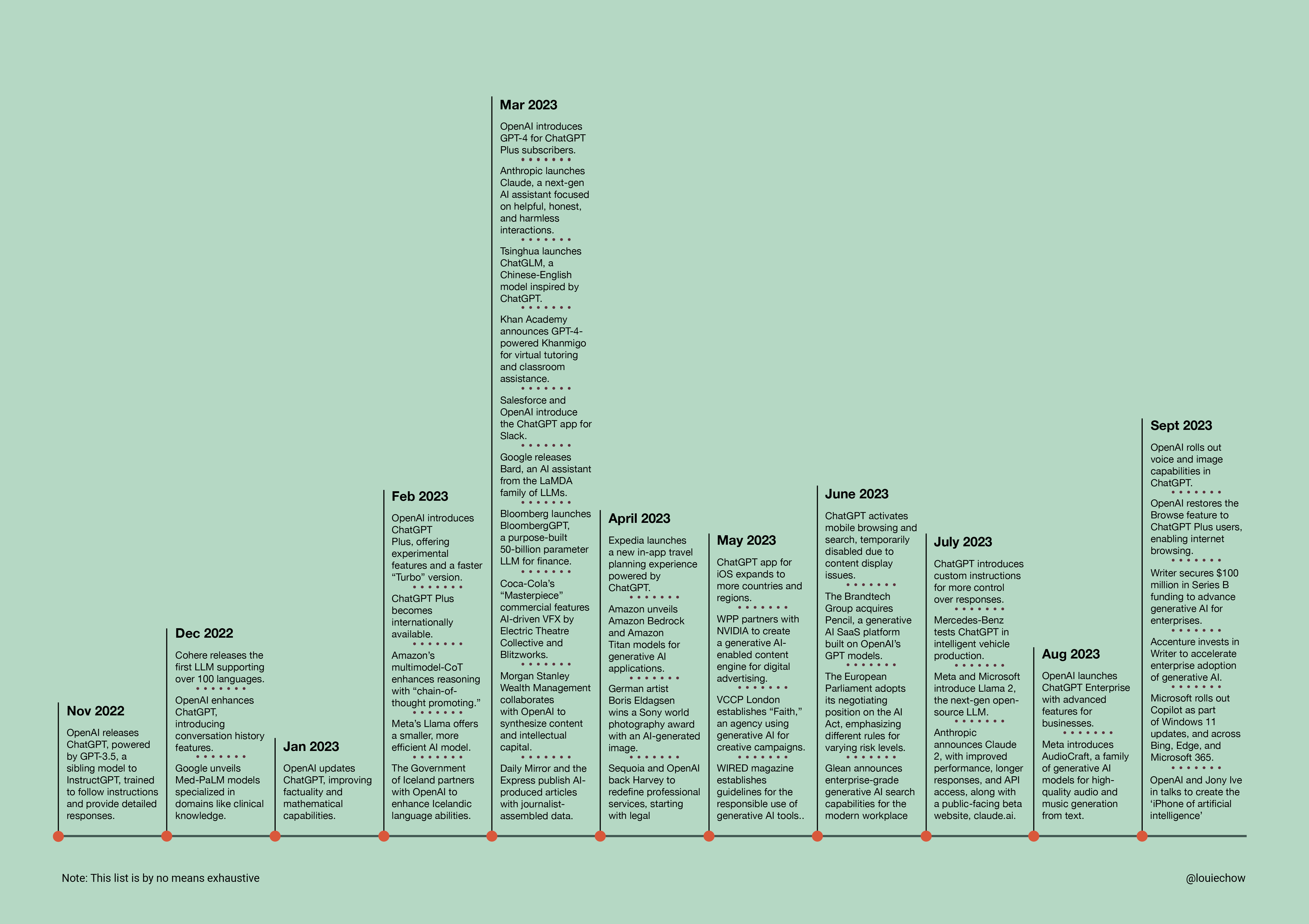
Here are the highlights (and some of the busiest months):
March – April: As the rapid development of Generative AI reached its zenith, companies across various sectors demonstrated a wide array of reactions. Tech giants like OpenAI and Meta continued to lead the charge with the introduction of GPT-4 and Llama 2, catering to both consumer and enterprise demands. Meanwhile, the Government of Iceland embraced this technology as a means to enhance the Icelandic language abilities, exemplifying how even governments are recognizing its potential. Coca-Cola launched new commercial entitled “Masterpiece”. The VFX team at Electric Theatre Collective and creative agency Blitzworks used a mix of live action shots, digital effects and AI to create the commercial and its complex transitions. In the corporate world, Morgan Stanley Wealth Management announced a strategic initiative to leverage Generative AI to synthesize content, underlining its increasing importance in the financial sector. Media outlets like the Daily Mirror and the Express ventured into AI-produced content, further blurring the lines between human and AI-generated journalism. Start-ups like Anthropic and Tsinghua joined the AI race, unveiling chatbots and models aimed at fostering helpful, honest, and efficient interactions. In education, Khan Academy‘s adoption of GPT-4 for Khanmigo emphasized AI’s role in revolutionizing learning. Expedia announced an exciting new use for artificial intelligence with the beta launch of a new in-app travel planning experience powered by ChatGPT. Finally, Bloomberg‘s launch of BloombergGPT in finance highlighted how industries are building purpose-built models to cater to their unique needs. These diverse reactions demonstrate how Generative AI’s impact transcends boundaries, with companies both big and small, across various sectors, recognizing its transformative potential.
May: The rapid development of Generative AI spurred creative and advertising agencies like WPP and VCCP into action. WPP, the global advertising conglomerate, partnered with NVIDIA to harness Generative AI’s capabilities for digital advertising. This strategic move showcased how the industry was eager to leverage AI to create innovative and highly personalized ad campaigns. Meanwhile, VCCP London took a bold step by launching “Faith,” an agency dedicated to using Generative AI for creative campaigns. This agency’s emergence signaled a pivotal shift in the creative landscape, demonstrating a readiness to explore the untapped potential of AI in generating compelling and unique content. These initiatives in May underscored how the advertising and creative sectors were proactively embracing Generative AI as a means to reimagine their creative processes and stay at the forefront of innovation in a rapidly evolving industry.
June: The acquisition of Pencil by the Brandtech Group marked a strategic response to the rapid development of Generative AI. Pencil, a generative AI SaaS platform built on OpenAI’s GPT models, offered a valuable tool for generating channel-ready ads and copy. The Brandtech Group’s acquisition showcased a clear recognition of the technology’s potential to revolutionize content creation and advertising, aligning with their objectives to enhance brand strategies through AI-driven creative solutions.
September: Accenture‘s investment in Writer demonstrated a deep commitment to accelerating the enterprise adoption of Generative AI. Writer‘s full-stack generative AI platform seems to have attracted attention from companies looking for a quality and secure environment. Accenture’s investment also signalled the importance of harnessing Generative AI for enterprise-level applications, from content generation to data synthesis, as a means to drive efficiency and innovation across various industries.
The industry’s response to ChatGPT’s launch has been nothing short of remarkable. Every development in the technology has been met with a closely-knit succession of events, demonstrating how companies are eager to keep pace with AI advancements.
As we delve into these insights, it becomes evident that Generative AI’s unstoppable progress is shaping the future of technology and business in profound ways.
Generative AI’s Next Act: Focus on Business Value
The swift adoption and incorporation of Generative AI models into various aspects of our lives demonstrate that this technology is not a distant dream; it’s a reality that’s here to stay. From content creation to virtual assistants, AI is drastically changing how we work, interact, and consume information. It has the potential to reshape industries and improve productivity across the board. In fact, Generative AI is now positioned on the “Peak of Inflated Expectations” on the Gartner “Hype Cycle for Emerging Technologies, 2023”, which is marked by rapid growth, widespread adoption, and a focus on speed as a strategic advantage.
The technology has already begun transforming industries and promises to continue doing so, fundamentally altering the way we live and work. This era of AI is unstoppable, and those who embrace it with agility and innovation will likely reap the greatest rewards.
Generative AI’s initial year was characterized by the discovery and deployment of foundation models, sparking a frenzy of novel applications that showcased the technology’s capabilities. These early apps were primarily technology-driven, offering lightweight demonstrations of Generative AI’s potential. However, as “Spring” is beginning to mature, the focus is shifting from technology-out to customer-back. In this phase, Generative AI is poised to address real human problems comprehensively. We will see applications take a different approach, integrating foundation models as a component of more holistic solutions.
We are also entering a phase where we will have a keen focus on the value we get from Generative AI — exactly how it will render business processes more effective and generate new services. We will start to understand that not everything possible is useful; and not everything useful delivers true value to the business. I will explore more on these developments in our next conversation.
 Louie Chow
You must be logged in to post a comment.